
If you’ve been searching for blackout blinds, you’ve probably imagined yourself in a bedroom so dark that you could sleep straight through a summer afternoon. After all, that’s what blackout window treatments are designed to do. But there’s a gap between what the label promises and what your windows can actually deliver.
The truth is that 100% blackout is rarely possible, but 98% is realistic when you use the right products and have the right installation. The difference almost always comes down to your windows, not the blinds or shades themselves.
This guide breaks down everything you need to know about light control. You’ll understand what blackout actually means, which products perform the best, and how professional installation affects the final result.
Do Blackout Shades Have to Be Dark Colors?
This is one of the most common surprises our customers have during our consultations. Most people assume that a blackout means it needs to be black, navy blue, or another deep shade. It doesn’t.
Blackout is determined by the fabric’s material content, not its color. Blackout window treatments are available in a full range of colors, including white. If you’ve been picturing dark, heavy window treatment that clashes with your bedroom’s design, that concern is off the table.
What’s The Difference Between Blackout, Room Darkening, and Light Filtering?
These three terms describe a spectrum of light control, but manufacturers don’t always use them consistently. That makes shopping more confusing than it needs to be.
Light Filtering: These treatments diffuse incoming light rather than blocking it. You lose direct glare from the sun, but the room stays bright. Light filtering treatments are ideal for living rooms and kitchens, where you want privacy without losing natural light.
Room Darkening: Treatments considered room darkening significantly reduce light. Most of the room is dim, but some glow typically remains, especially around the edges of your window. It’s worth knowing that some manufacturers market products as “room dimming” rather than room darkening. They may use blackout material in part of the shade’s construction, but the overall structure allows light to come through.
Blackout: These treatments use materials that are specifically designed to block nearly all light transmission through the fabric itself. The crucial part to understand here is that it’s light moving through the fabric. As we’ll cover next, fabric is only part of the equation.
Why Don’t Blackout Shades Block 100% of Light?
This is the question most customers don’t think to ask until they’re standing in a room that’s almost — but not quite — dark enough.
The shade itself isn’t the problem. A true blackout fabric blocks virtually all light that passes through it. What lets light into the room are the gaps between the treatment and the window frame. Those gaps exist in every installation to a varying degree.
Tami Hoffer, owner of Best Blinds in Fort Wayne, says she and her team address this directly with every customer.
“While the shade itself will be a complete blackout, there will be unavoidable gaps between the window frame and the shade that will allow light to sneak through the edges,” she says. “We help guide people on what product types have smaller edge gaps than others.”
There’s a solution for windows with enough depth. A light block side track system can attach to the interior of the window frame and seal off edge gaps, getting you as close to true blackout as your windows allow.
“Side tracks are either in an L or U shape,” Tami says. “Some are adhered to the window frame with magnetic or double-sided tape, and others are drilled into the window trim.”
Not every window qualifies, though. Side tracks require at least two inches of flat surface depth, and casement windows — the kind with cranks and locks along the frame — can present obstacles that make the system impractical.
For windows that can’t accommodate a track system, a simple one-panel drape on each side of the window can cover the remaining edge gaps. It’s a straightforward workaround that many customers land on once they understand the full picture.
The takeaway here is that 98% light blocking is realistic for most homes, but it depends on your window configuration as much as the product you choose. That’s exactly why seeing your windows in-person matters before making a decision.
Which Window Treatments Block the Most Light?
Not all blackout products perform equally in real-world installations. The fabric used matters, but so does the structure of the shade. Specifically, how much of a gap it leaves at the edges.
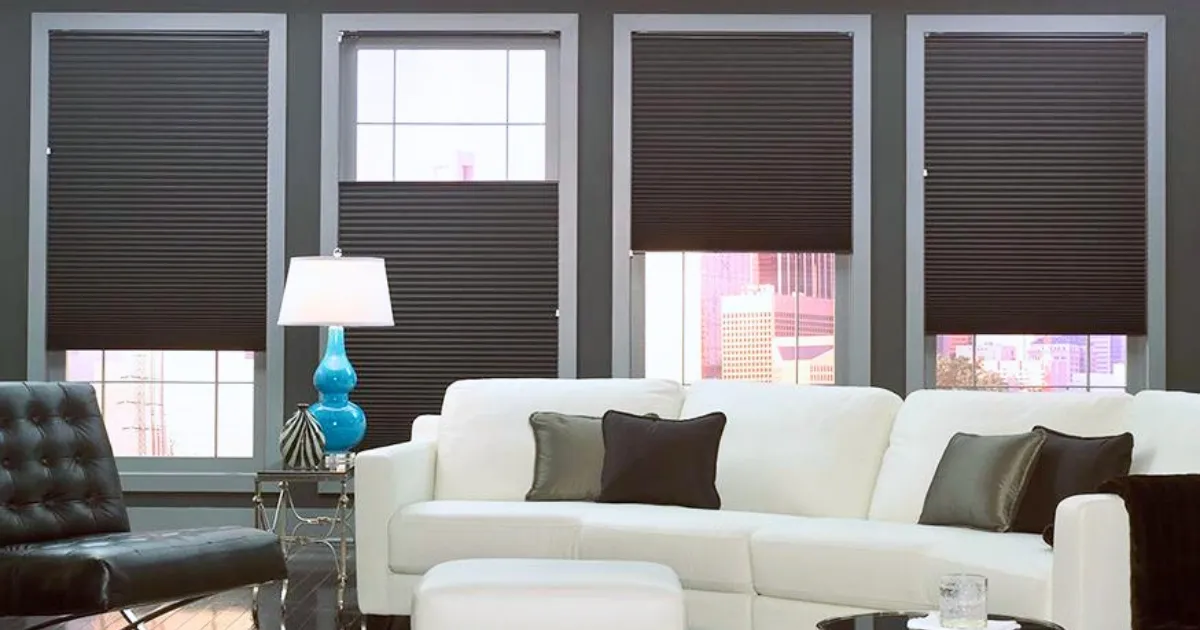
For serious light control, cellular shades (also known as honeycomb shades) are the top performers.
“In our opinion, the best in the industry are the blackout cellular shades,” Tami says. “It has the smallest gap out of any product.”
Beyond light blocking, cellular shades also offer a feature worth knowing about: top-down/bottom-up operation. This function lets you lower the shade from the top while keeping the bottom covered. For a bedroom, that means you can bring natural light in while getting dressed without sacrificing privacy, and then drop it fully when you’re ready for sleep.
Roller shades are a popular choice, and blackout fabric options are widely available. But Tami explains that they have an important, real-world limitation.
“Roller shades of all varieties have large edge gaps. Therefore, while the fabric itself is considered blackout, the amount of light that can come through the edge gaps is a stark contrast and feels especially bright.”
If your priority is maximum darkness, that’s a meaningful tradeoff to weigh before you commit.
Shutters and vertical blinds can reduce light substantially, but neither achieves true blackout. Louver gaps on shutters and the nature of vertical slat construction allow some light through. They’re strong options for privacy and light reduction, but customers with serious darkening needs usually land on cellular or roller shades as their primary choice.
Does Inside or Outside Mount Make a Difference?
Yes, and it’s worth understanding how before you decide.
With an inside mount, the shade installs within the window frame. This typically delivers better light control because it positions the shade closer to the glass and, importantly, makes the side track system an option if your window depth allows for it.
Outside mount installs the shade on the wall above the window frame. The shade covers more surface area, but light can still enter behind the shade where it doesn’t seal against the outer trim.
That said, outside mount isn’t a bad choice; it has a different set of tradeoffs. For windows that are too shallow for a track system, regardless of mount type, the difference between the two narrows considerably.
A professional measurement and consultation can help you understand which approach makes sense for each window in your home, since the answer isn’t always the same from room to room.
Who Benefits Most from True Blackout?
Blackout window treatments serve a range of needs, and the right setup can look a little different depending on why darkness matters to you.
For most bedrooms, the goal is flexibility as much as darkness. You want the room to be cave-dark when you’re sleeping, but you still want usable light the rest of the time. Research consistently links darker sleep environments to better melatonin production and overall sleep quality. That’s where the top-down/bottom-up feature of cellular shades earns its place. You get full blackout when you need it without committing to a dark room all day.
Shift workers and anyone sleeping during the daylight hours tend to be the most sensitive to light leakage. Side tracks and side panel drapes are also an excellent choice for this type of person. If your sleep window falls during peak daylight hours, it’s worth going the extra mile on installation.
Home theater and media rooms have a slightly different priority. The goal is reducing glare and improving contrast on screen rather than creating sleeping conditions, so room darkening shades often do the job without needing a full blackout setup. That said, dedicated theater spaces with serious equipment usually benefit from going all the way.
For nurseries, it all comes down to the baby. Some sleep under any conditions, while others are sensitive to every sliver of light. Tami takes her cues from the parents. However, she offers a lighthearted word of caution from personal experience.
“I always share that I had to remove my son’s blackout shade when he was 12 years old, because he had no concept of what time of day it was,” she says. “I had to keep waking him up to get his chores done!”
A useful reminder that blackout shades work — sometimes a little too well.
Can Blackout Shades Also Protect Against UV Fading?
Light blocking and UV blocking aren’t the same thing, but they’re closely related, and blackout shades do double duty here.
Blackout material blocks 100% of UV rays that pass through the fabric. For furniture, flooring, and artwork near windows, that’s meaningful protection.
The real-world caveats are the same ones that apply to light blocking: UV rays can still sneak through edge gaps, and the protection only applies when the shades are fully lowered. A shade that stays raised half the day offers limited UV protection during those hours.
It’s worth noting that most newer windows include a glazing on the glass that reduces — but doesn’t eliminate — UV transmission. And many upholstery fabrics also incorporate polyester fibers, which resist fading naturally.
For homes where fading is a serious concern — think original hardwood floors, valuable artwork, or leather furniture in a sun-heavy room — Tami suggests considering window film as a complement to your window treatments. Quality window film can block up to 99% of UV rays regardless of whether your shades are raised or lowered, adding a layer of protection that works around the clock.
Ready to Find the Right Light Control Solution for Your Home?
Schedule a free, in-home consultation, and we’ll bring working models of our blackout and room darkening shades directly to your home in the Fort Wayne area. See how cellular shades operate, understand your edge gap options, and get honest guidance on whether a side track system makes sense for your windows.
No pressure, just practical information from a local team with 37 years of combined experience in window treatments.
Call 260-490-4422 or visit our website to schedule your consultation.