
If you’ve been hearing more about motorized blinds lately, you’re not imagining it. New safety regulations, smarter technology, and lower costs have moved motorized treatments from a “nice luxury feature” to a practical option for many homeowners.
To be upfront, motorized blinds are easy to use, more affordable than in the past, and they solve real problems, especially if you have hard-to-reach windows, mobility concerns, or children in your home.
Let’s discuss how motorization works, what your options are, and whether it makes sense for your home.
How Do Motorized Blinds Actually Work?
Motorized blinds sound more technologically complicated than they actually are. In short, they consist of a small motor sitting inside the headrail of a set of blinds or shades, which you control with a switch, remote, or app on your phone. That’s it. Press a button or set a timer, and your blinds do the rest.
Everyday Operation
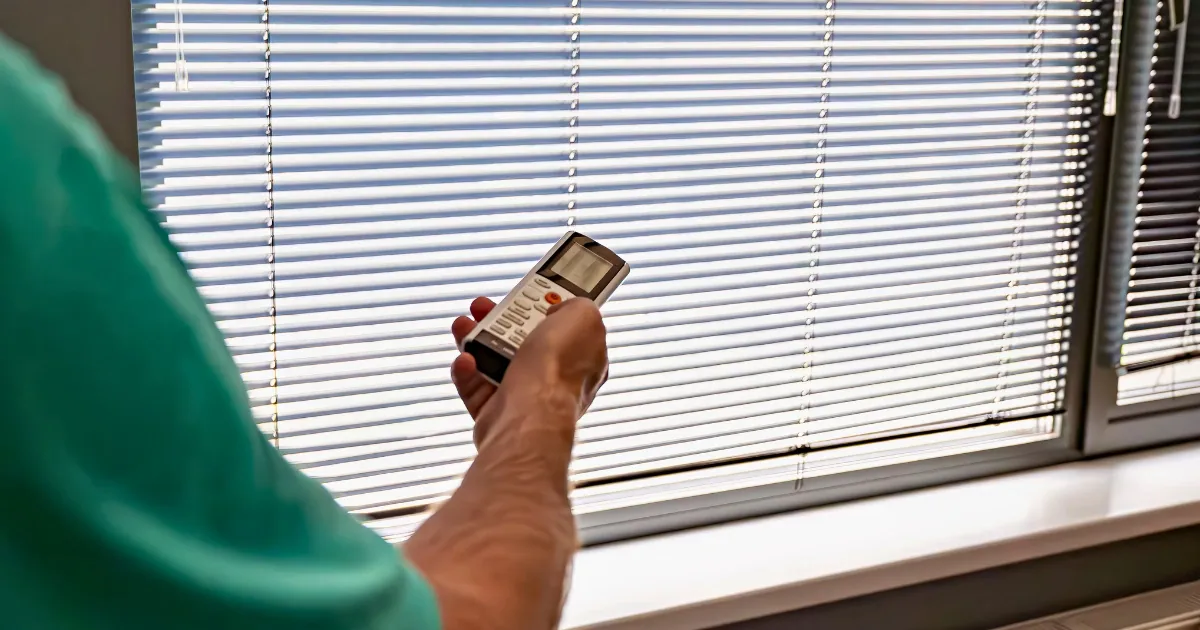
For the majority of motorized blind owners, a simple handheld remote is all that’s needed. Each shade comes pre-programmed with three settings: all the way up, all the way down, and a “favorite” position that you specify.
However, you’re not limited to those positions. You can stop the shade anywhere along the way by pressing a button while it’s moving. If you want your shade to open exactly 18 inches from the sill, you can do that.
A common misconception in Fort Wayne is that motorized blinds require individual remotes for each window. In fact, a remote has multiple channels, so one controller can operate individual shades, groups of shades, or all at once. You can customize the programming to your needs.
Smart Home Integration and Automation
For even more control over motorized blinds, you can connect to a smart home system and operate your window treatments through a third-party system or a phone app. This opens you up to the ability to create scenes, which are automated schedules that raise and lower your shades at specific times.
For example, you may want to set your bedroom shades to automatically raise at 8 a.m. during the week and lower at 7 p.m. Or, you could program your living room shade to close during the hottest part of the day to help lower cooling costs.
This doubles as a great security feature, too. If you travel on vacation or head out for the evening, you can operate your shades remotely to make it appear as if someone is home. It’s a simple way to add an extra layer of security to your home without extra equipment.
It’s important to note that if the battery in your motorized blinds dies or the motor has an issue, you can’t manually operate the shade. It won’t move until the problem is fixed. The good news is the shade warns you ahead of time. An indicator light starts blinking when the battery is getting low, and if you recharge when you see it, this limitation rarely becomes a problem.
Battery-Powered vs Hardwired: What’s the Difference?
Fortunately, hardwired and battery-powered blinds function the same way and have the same features. The biggest difference comes down to the source of power and the type of maintenance required. Neither type is necessarily better than the other. Ultimately, it comes down to what makes the most sense for your situation.
Battery-Powered Motorization
Let’s dispel a myth right away. Battery-powered blinds don’t use disposable batteries like the ones you buy at the store; they use rechargeable lithium-ion batteries. So, you don’t have to worry about buying AA batteries in bulk every few months.
You will, however, need to recharge the batteries once every 6 to 12 months, depending on how often you operate your shades.
“Recharging batteries versus changing them out is a much easier process,” says Tami Hoffer, owner of Best Blinds in Fort Wayne. “Most manufacturers offer a magnetized recharging cord that makes snapping in the cord easier.”
The key is not letting the batteries get completely depleted. Depending on how long they stay dead, Tami says the shade can lose its pairing with the remote. If that happens, the remote has to be re-paired and the shade’s limits reset before it will work again. You can find YouTube tutorials that walk you through it, or Best Blinds can come out and reprogram it for you. As a best practice, add “recharge motorized blinds” to your spring and fall home maintenance checklist, the same way you’d replace your furnace filter.
Needing to get on a ladder to recharge your motorized blinds is a common concern, especially for high windows. But Best Blinds can install extension wires down to eye level for ease of recharging, removing the need for a ladder or step stool.
Battery-powered shades are a practical choice for most people, as they work best in existing homes where running electrical wiring through finished walls would be invasive. They’re also a great option when there are no nearby outlets, and you want to avoid running visible cords down your walls.
Bear in mind that WiFi setups can affect your battery usage. It’s not generally a dealbreaker, but if you plan to integrate your motorized blinds with a smart home system, it will likely require more frequent charging.
Hardwired/Electrical Motorization
Motorized shades that are hardwired connect directly to your home’s electrical system. That means zero battery maintenance.
To have hardwired blinds, you need to do one of two things:
- Run wiring through the walls from a power source to each window. This is a good option for new builds or if you’re planning renovations and have exposed wiring. It’s possible with finished walls, but it will require extra work.
- Using a cord to plug into an outlet. While this is a functional option, it’s not often popular because the cord will be visible, and it’s at odds with the clean look most homeowners want.
“The best-case scenario for electrical or hardwired motorization is when someone is building a house, and the drywall has not been completed yet,” Tami says. “We coordinate and provide consulting to the electrician on the type of wiring needed, placement of the wires, power sources, and more.”
If you’re building a new home or planning major renovations where your wiring will be exposed, it’s worth contacting Best Blinds during the planning stage.
You can complete the connections anytime before the drywall is installed, but earlier coordination ensures everything is streamlined, and the electrician knows exactly what’s needed.
The bottom line is that if you’re in an existing home and don’t want visible cords, battery-powered blinds are the best answer. If you’re building a new home or doing renovations, hardwiring is an option for maintenance-free operation. Both work equally well; your personal circumstances are the biggest factor.
What Are the Practical Benefits Of Motorized Blinds?
Most homeowners think about motorized shades as a convenience. That’s part of it, but there are also less obvious advantages to consider.
Energy Efficiency Through Automation
Motorized blinds can help reduce your heating and cooling costs, but only when used strategically. The advantage comes through automation, letting it happen consistently without requiring you to remember.
The energy savings depend on your windows, your climate, and how strategically you program your shades. However, a recent study from Illinois Tech suggests that using motorized shades can decrease energy use by up to 25% for heating and cooling.
Safety and Independence for Mobility Issues
For people with mobility issues, motorization offers more than just ease of use.
“For people with mobility issues, it can make them feel more independent,” Tami says. “It also keeps them from putting themselves in situations where an accident can occur, such as reaching over furniture to operate shades.”
If you’re aging or face mobility issues, not having to reach over a chair to raise or lower a set of heavy shades removes a real safety risk. It also keeps you from potentially losing balance and falling.
Why Are Motorized Blinds Becoming More Popular?
A decade ago, motorized blinds were most often seen only in high-end homes. Today, they’re showing up more often in everyday homes across Fort Wayne. Two big shifts have had a huge impact on that.
New Cord Safety Laws Changed the Landscape
Industry safety mandates have all but eliminated corded window treatment options. Child safety concerns largely drove this change, particularly for young children who could get caught or tangled.
The new standard is cordless manual operation, which is safer, but it creates its own challenges. Tall windows or windows that are blocked by furniture make manual operation difficult.
“If you have an 8-foot window or a window above a built-in bench, reaching up to pull down a cordless shade isn’t practical,” Tami says. “And it’s certainly not safe if you’re standing on furniture to do it.”
Motorization solves that problem completely. No cords and no climbing required. You operate the shade from across the room with a remote and zero fuss. Tami adds a lighter benefit.
“For teenagers who would prefer to sleep all day, motorization is a great parenting tool,” she says. “Just raise the shade automatically at a specific time and help them get up and get their chores done!”
The Technology Has Improved and Become More Affordable
In the old days, motorization meant expensive custom systems with proprietary remotes and product support that was questionable at best. Those days have changed.
Rechargeable batteries mean less maintenance and waste. Motors are quieter and more dependable, and integration with smart home systems and phone apps makes them simple to control.
Costs have come down, too. While it’s still an investment compared to manual operation, they’ve moved from “out of reach for most people” to “worth considering if it solves a real problem for you.”
“During consultations, we discuss the pros and cons of motorized blinds and educate homeowners on what motorization can and cannot do,” Tami says. “This lets homeowners decide for themselves if the convenience is worth the cost to them.”
If you have tall windows, mobility concerns, or want automated energy management, the value motorization provides is clear. If your windows are easy to reach and you rarely adjust them, then manual operation may be perfectly fine. Ultimately, it’s about making an informed decision based on your needs.
What About Retrofitting Existing Blinds or DIY Options?
If you already have blinds or shades that you like, you may be wondering if you can simply add motors to them rather than buying entirely new window treatments. If you’re a DIYer, you may also be considering a motorization kit and trying to upgrade it yourself. Here’s what you should know about both.
Can You Add Motors to Existing Blinds?
In short, you can sometimes add motors to existing blinds, but not usually. Those situations are extremely limited, and the technology for retrofitting isn’t very far along.
“There are a few situations that we are able to retrofit motors into the headrail of an existing manual shade,” Tami says. “There may be more development of this in the future, but right now it’s generally not feasible.”
Most motorization requires new shades. The motor is built directly into the headrail from the factory and customized to your window, meaning everything will be integrated properly from the start.
What About DIY Motorization Kits?
DIY kits do exist, and they can work. However, they come with trade-offs that are worth understanding before you attempt to give it a try.
“Frequently, the DIY kits have components that are exterior to the shade,” Tami says. “Either a battery wand and/or a box for that motor have to be installed or attached to the window frame or to the control mechanism of the existing shade. That makes them visible and not very attractive.”
Not only do you end up with visible hardware that detracts from the overall clean look most people want, but there’s an issue of fit.
Commonly, the adapters that a DIY kit manufacturer sends to secure your motor may not fit your shade. Meaning you may order a kit, take apart your shade, and discover nothing lines up.
On top of that, Tami points out that many DIY kit manufacturers are not well-known companies. Troubleshooting or support for your kit may be nonexistent, and the company may not exist a few years down the road if you need replacement parts.
How Do You Know If Motorization Is Right for Your Home?
Motorized blinds aren’t for everyone, and that’s okay. The question to ask yourself is: “Does this solve a problem for me, or does this create more complexity that I don’t need?”
Motorization makes the most sense when you:
- Have tall or hard-to-reach windows
- Want smart home integration
- Have mobility concerns or want aging-in-place features
- Are building a new home
- Want to eliminate cord safety hazards
- Want automated energy management
- Adjust your shades frequently throughout the day
At Best Blinds, we work with you to figure out if motorization fits into your unique situation.
Schedule a free, in-home consultation, and we’ll bring working models of motorized blinds directly to you. See how they operate, test the controls, discuss battery vs. hardwired options, and get honest guidance. Then, you decide based on your priorities, budget, and how you actually use your home.
Call 260-490-4422 or send us a message to schedule your consultation.